Disclosure: This post contains affiliate links. If you buy through these links, we may earn a small commission at no extra cost to you.
GTA VI Ultimate Guide → yxgonglue.com/gta-vi/
GTA V gave you three protagonists and zero relationships between them. Michael and Trevor shared a past they never resolved. Franklin floated between both men as the newcomer with no leverage. You could switch characters at will, and exactly nothing changed based on how they felt about each other.
The GTA 6 trust system is Rockstar’s answer to that flatness. Leaked design documents, patent filings, and consistent insider reporting all point to the same thing: Jason and Lucia’s relationship is not just a story beat. It is a gameplay mechanic. Your choices as either character affect how they treat each other. That trust — or lack of it — changes dialogue, mission availability, combat behavior, and potentially the ending itself.
Here is how the GTA 6 trust system works based on everything we know — what the leaks say, what the patents describe, and what realistic expectations look like when the game launches on November 19.
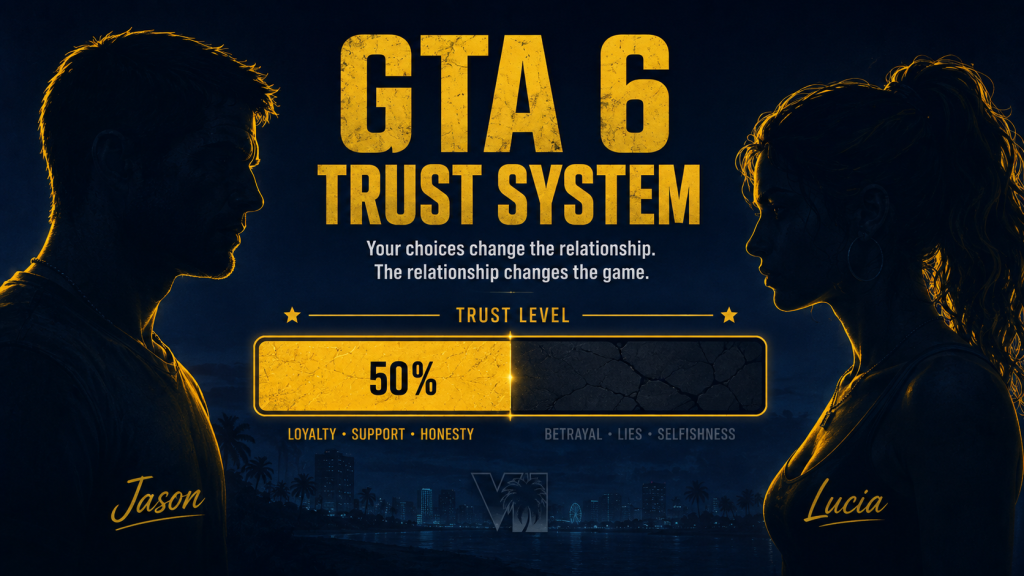
What the Trust System Actually Is
The GTA 6 trust system is a relationship meter between Jason Duval and Lucia Caminos. It tracks how they treat each other across the campaign and adjusts their interactions accordingly. Think of it as an invisible score that ticks up or down based on decisions you make during missions, dialogue choices, and actions in the open world.
The system first surfaced in a Rockstar patent filed in 2021 and published in 2023. That patent describes a “virtual character personality engine” that adjusts NPC behavior based on accumulated player actions over time. Its language is technical and deliberately broad — patents always are — but the core idea maps directly onto what insiders have described for GTA 6: two playable characters whose relationship state shifts in gameplay rather than just in cutscenes.
Industry reporter Jason Schreier confirmed the trust mechanic in his August 9 Bloomberg report on GTA 6’s single-player focus. Schreier’s sources describe a system where lying to one character as the other, ignoring warnings during missions, or making selfish decisions erodes trust. Over time, low trust changes how the two protagonists interact during combat, what information they share with each other, and which ending paths become available.
This is not a dating sim. Rockstar is not building a romance game. The trust system is a tension mechanic — a way to make the Bonnie-and-Clyde dynamic feel like something you participate in rather than something you watch. Healthy relationships do not make good crime stories. Relationships under pressure do.
How Trust Goes Up and Down
The leaked design documents describe several categories of trust-affecting actions. None of this is officially confirmed, but the leaks have been consistent across multiple sources.
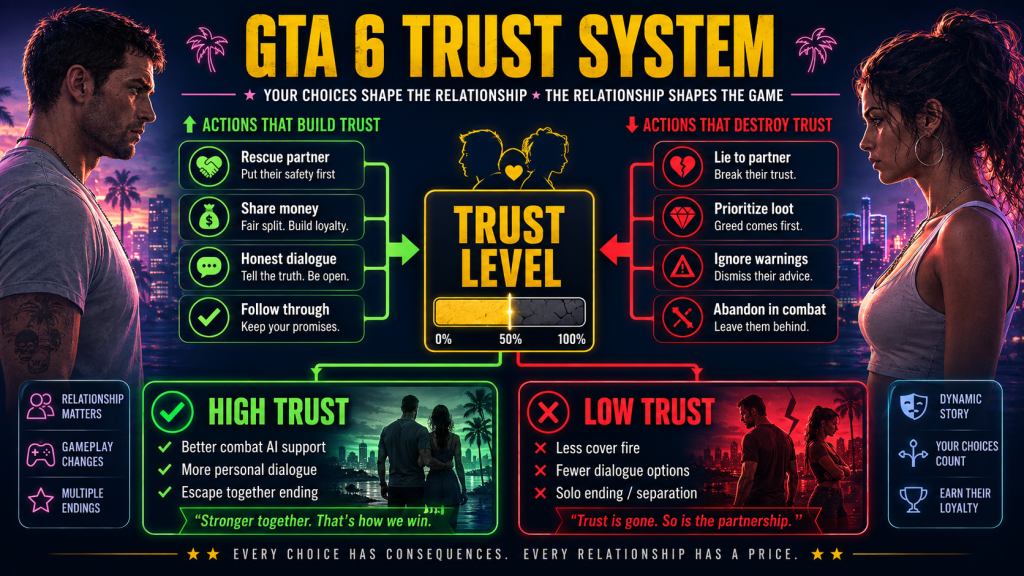
Actions that increase trust:
- Having one character rescue the other during combat rather than completing the objective first
- Sharing money or resources rather than keeping a larger cut
- Making dialogue choices that are honest rather than deceptive
- Following through on promises made in earlier missions
- Protecting the other character in situations where you could let them take the fall
Actions that decrease trust:
- Lying during dialogue — especially about mission stakes or money splits
- Prioritizing loot over the other character’s safety
- Making decisions that benefit your character at the other’s expense
- Ignoring warnings or suggestions from the other character during missions
- Abandoning the other character in combat to complete an objective solo
The leaks suggest trust changes are mostly invisible during gameplay — no pop-up that says “Trust -5” after you grab the cash and leave Lucia behind. Instead, you notice the effects later. Lucia stops warning you about enemies on her flank. Jason hesitates before covering your exit. The feedback is behavioral, not numerical. That makes the system feel like part of the story rather than a minigame you optimize.
What Changes Based on Trust
This is where the trust system gets interesting. The effects are not cosmetic. They touch multiple layers of the game.
Dialogue and Cutscenes
The most immediate effect is what the characters say to each other. High-trust Jason and Lucia have different mission dialogue than low-trust versions. A high-trust Lucia might say “I’ve got your back” before a shootout. A low-trust Lucia might say nothing at all, or worse, say “Don’t screw this up.” These differences are not just flavor. They change how you feel about the characters and the decisions you make next.
The motel argument scene from Trailer 1 — Lucia standing with arms crossed, Jason sitting on the bed looking defeated — is likely a low-trust version of that story beat. A high-trust version of the same scene might play completely differently. Same plot point, different emotional weight, different context for every mission that follows.
Combat Behavior
The leaks describe trust affecting how the AI partner behaves during missions. A high-trust partner is more aggressive about covering you, calls out enemy positions more frequently, and prioritizes your safety over objectives. A low-trust partner is slower to provide covering fire, less communicative about threats, and more likely to prioritize their own position over yours.
This is not just a difficulty slider. A low-trust partner is not weaker. They are less cooperative. The distinction matters because it means you cannot simply compensate with better shooting. You have to compensate for a partner who is not fully on your side. That is a more interesting design problem than “enemies do more damage.”
Mission Availability and Branching
Some missions reportedly only become available at certain trust thresholds. A high-trust duo might unlock a mission where they rob a target together. A low-trust duo might get a version where one character goes behind the other’s back to set up the same job solo. The mission is similar in structure but different in context, and depending on which version you get, the trust score moves further in that direction.
This is the part of the system that has the biggest implications for replayability. If mission availability genuinely branches based on trust, a single playthrough only shows you one version of the Jason-and-Lucia story. You would need a second run — making different choices, building or breaking trust in different ways — to see the other half of the content. Rockstar has never done this before at scale.
Endings
The most significant trust effect is reserved for the finale. Multiple insiders have described binary or trinary ending paths that depend on the accumulated trust score across the entire campaign. A high-trust ending might let both characters survive and escape together. A low-trust ending might force a choice where only one walks away, or where the partnership collapses before the final job is even finished.
This mirrors the structure Rockstar used in GTA V — kill Trevor, kill Michael, or Deathwish — but with a critical difference. In GTA V, the ending choice came at the very end, disconnected from everything you had done for the previous 30 hours. In GTA 6, the ending is the sum of every trust decision you made across the entire campaign. You do not pick your ending. You earn it.
What the Patent Reveals
Rockstar’s 2021 patent, published in 2023, describes a system for “dynamically adjusting character behavior based on accumulated interaction history.” The patent language is dense, but the core mechanics are clear enough to map onto what insiders describe.
The system tracks multiple behavior vectors — cooperation, honesty, aggression, resource sharing — and uses them to adjust how NPCs respond to the player. In the patent examples, an NPC who has been lied to repeatedly becomes less trusting in future interactions. An NPC who has been rescued in combat becomes more protective. The system is designed to work across any NPC, not just protagonists.
Applied to Jason and Lucia, the patent describes exactly the kind of mutual tracking system the leaks outline. Both characters maintain a relationship state based on how the player — controlling either character — has treated the other. The state persists across missions and accumulates rather than resetting. The effects compound over time rather than triggering at fixed thresholds.
The patent also describes an “escalation” mechanic where low trust leads to more severe consequences the longer it persists. A single lie might not change much. A pattern of lies across five missions might lock you out of certain dialogue options, then certain missions, then certain endings. The system tightens over time rather than punishing you immediately.
Why the System Might Be More Limited Than It Sounds
Patents and leaks describe an ideal version of a system. Shipped games describe the version that actually survived development. There are reasons to set expectations below what the patent describes.
The GTA V Warning
Rockstar filed the trust system patent in 2021, when GTA 6 was reportedly in a state of significant re-scoping. Bloomberg reported in 2022 that Rockstar had cut a planned third playable character and reduced the map scope to ease crunch and focus development. A system as complex as a fully branching relationship mechanic is exactly the kind of feature that gets scaled back when a project needs to ship.
The same thing happened with GTA V. Pre-release previews described a dynamic heist system where you could recruit crew members with different skill levels, plan approaches, and deal with consequences that rippled across missions. What shipped was heists reduced to linear set-pieces with predetermined crew members and limited branching. Real ambition, constrained by the reality of shipping a game that also had to work.
What Realistically Survives
The GTA 6 trust system will exist. Schreier’s reporting confirms it. But it will probably be closer to a persistent dialogue-and-ending modifier than a full branching narrative engine. Trust will change what characters say, how they fight alongside you, and which ending you qualify for. It will probably not lock you out of major story missions or create entirely different campaign structures for high-trust and low-trust paths. In fact, that level of branching is hard to do in a linear game and harder to do in an open-world game of this scale.
The safe bet: expect a system that makes the relationship feel alive and reactive, not a system that transforms GTA 6 into a choice-driven RPG. Rockstar makes action games with strong stories. The trust system serves the story. It does not replace it.
Why This Mechanic Matters to Me
I write 900 words about a mechanic Rockstar has never officially confirmed because it fixes the thing that bothered me most about GTA V. I replayed that game last year and realized I did not care whether Michael, Franklin, or Trevor lived or died. The ending choice should have been brutal. Instead it was a menu prompt. Pick A, B, or C. I picked C because the internet said C gave you the most content.
Not because I cared. If the GTA 6 trust system works as described, the ending is not a menu. The choice already happened — across 40 hours, across dozens of missions, across every time I decided whether Jason mattered more than the score. That is not a marketing pitch. It is a design philosophy. Whether Rockstar ships it or scales it back, the fact that they are trying it at all tells you something about what GTA 6 wants to be.
Quick Answers
Q: Can Jason and Lucia break up permanently before the end of the game?
Almost certainly not. A permanent mid-game breakup would lock players out of missions designed for both characters. The trust system can degrade the relationship to a low point, but the story needs both protagonists available through the finale. The ending might let them split permanently. The middle of the game will not.
Q: Does trust affect which character you play as?
The game reportedly assigns specific characters to specific missions based on story context — same as GTA V. Trust does not change which character you control in a given mission. It changes how the other character behaves while you control the active one.
Q: Can you max out trust early and coast through the rest of the game?
Based on the patent description, probably not. The system is designed to decay naturally if you stop making trust-positive choices. Maintaining high trust requires consistent behavior across the campaign, not a burst of good decisions in the first few hours.
Q: Does trust carry over into a New Game Plus or second playthrough?
Rockstar has not confirmed a New Game Plus mode for GTA 6. If one exists, trust would likely reset with each new playthrough, same as any other progression system.
Q: Is the trust system confirmed or still a rumor?
Parts of it are confirmed. Jason Schreier’s August 9 Bloomberg report describes “a branching trust system” as part of the single-player campaign. The patent provides the technical framework. The specific mechanics — how trust goes up and down, exactly what it affects — are based on leaked design documents and have not been officially detailed by Rockstar.
Bottom Line
The GTA 6 trust system is the biggest mechanical innovation Rockstar has attempted since the character-switching in GTA V. It takes something that was previously confined to cutscenes — the relationship between the two main characters — and turns it into a gameplay system with consequences that accumulate across the entire campaign.
It will not be as deep as the patent suggests. It will be deeper than anything Rockstar has shipped before. The truth sits in the middle, and the Extended Look on August 27 might be the first time we see it in action. Watch for a moment where Jason and Lucia interact differently based on context that is not scripted. If you see Lucia hesitate before covering Jason, or Jason check on Lucia without being prompted, that is the trust system. Not a cutscene. A mechanic.
More GTA VI Guides: GTA VI Ultimate Guide Hub → | GTA 6 Characters: Jason & Lucia | GTA 6 Single-Player First | GTA 6 Extended Look Aug 27 | GTA 6 No Physical Disc
As an Amazon Associate we earn from qualifying purchases. PS5 Console | Xbox Series X