Disclosure: This post contains affiliate links. If you buy through these links, I may earn a small commission at no extra cost to you.
If you are comparing a Steam sale with a cheap game key, the lowest number is not always the lowest cost. A $60 game may fall to $30 on Steam, while a key site lists it at $24. That looks like an easy win. Then you notice a checkout fee, a region lock, or a refund policy that disappears the moment you reveal the key.
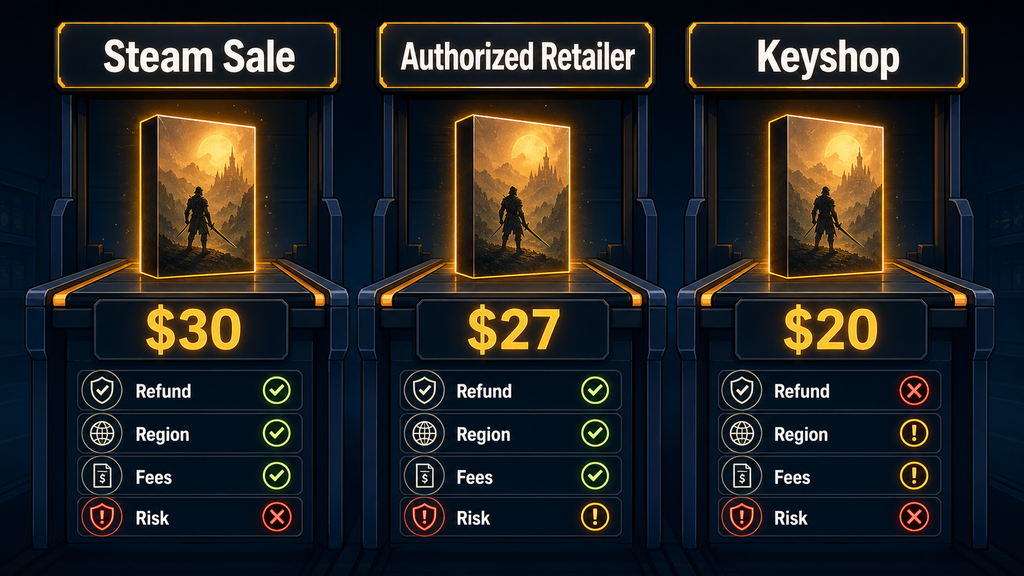
Here is the short answer: Steam is usually the better buy when you want a simple refund path and a low-risk purchase. An authorized key retailer can beat Steam when it has a genuine publisher-backed promotion. A grey-market keyshop may show the lowest price, but it carries the highest uncertainty. Cheap is not the same as good value.
Steam Sale vs Key Sites: The Quick Verdict
| Buying option | Typical advantage | Main drawback | Best for |
|---|---|---|---|
| Steam seasonal sale | Clear checkout, account support, standard refund rules | The price may not be the lowest | Buyers who want the safest simple purchase |
| Authorized key retailer | Sometimes lower than Steam, legitimate publisher supply | Smaller catalog and different refund rules | Deal hunters who still want a known retailer |
| Grey-market keyshop | Very low advertised prices | Seller, region, chargeback, and refund risk | Experienced buyers who accept the risk |
Steam runs four major seasonal sales each year. The next listed event is the Autumn Sale, from October 1 to October 8, 2026. A seasonal sale is not the only time Steam discounts games, but it is a useful date to put on your calendar.
Steam also has one important advantage after checkout: its standard PC game refund rule generally covers purchases made within 14 days with less than two hours of playtime. That protection does not automatically transfer to a third-party key purchase.
What Makes a Steam Deal Cheaper?
Steam gives you a visible base price, a discount, and the payment total before you confirm the purchase. That makes the calculation easy:
Steam total = sale price + any tax shown at checkout.
The bigger question is whether the current sale price is close to the game’s historical low. A 25% discount can look impressive while still being higher than a 50% discount from a previous event. Before buying, check the game’s price history with a comparison tool such as IsThereAnyDeal. It tracks price history and covers authorized resellers rather than grey-market marketplaces.
For example, imagine a game with a $59.99 list price:
| Scenario | Advertised price | Extra cost | Real total |
|---|---|---|---|
| Steam, 50% off | $29.99 | $0 | $29.99 before tax |
| Authorized key retailer | $26.99 | $0 | $26.99 before tax |
| Keyshop listing | $21.99 | $3.50 fee | $25.49 before tax |
In this example, the keyshop is not actually cheaper than the authorized retailer. The difference from Steam is only $4.50, and the buyer may be accepting more risk to save that amount.
Prices change by country, currency, tax rules, coupons, and stock. Treat this table as a calculation example, not a live quote. Check the final checkout total before making a decision.
When an Authorized Key Retailer Beats Steam
An authorized retailer can be a strong middle option. IsThereAnyDeal says the stores it covers source keys directly from publishers or authorized distributors, and it excludes marketplaces and grey-market shops.
That distinction matters. A legitimate retailer may sell a Steam key for less because the publisher approved a separate promotion, bundle, or regional campaign. You still need to check three details:
- The activation platform. A PC key may activate on Steam, Epic Games, EA, Ubisoft Connect, or another launcher.
- The region. “Global,” “EU,” “NA,” and “ROW” do not mean the same thing. A key can be cheap because it is restricted to a different market.
- The refund rule. Some stores refund only unrevealed keys. Once you display the code, your options may shrink.
This is where a slightly higher price can be worth it. If an authorized retailer is $2 more than a marketplace but gives you a clear support process, the extra $2 is buying less uncertainty.
Why the Cheapest Keyshop Price Can Mislead You
Grey-market marketplaces can display very low prices because independent sellers list keys from different sources. The platform may process the order, but that does not mean it created or originally supplied every key.
The risk is not only that a code fails immediately. A key can be region-locked, already used, incompatible with your account, or later revoked if the original transaction is disputed. A buyer can also lose time arguing with a seller about a refund.
The Federal Trade Commission recommends checking seller rules, refund support, and safe payment methods when buying through an online marketplace. It also warns against sellers who demand gift cards, wire transfers, or cryptocurrency because those payments are difficult to reverse.
If a listing is dramatically below both Steam and authorized retailers, stop and ask why. Sometimes the seller has a real promotion. Sometimes the low price is the warning.
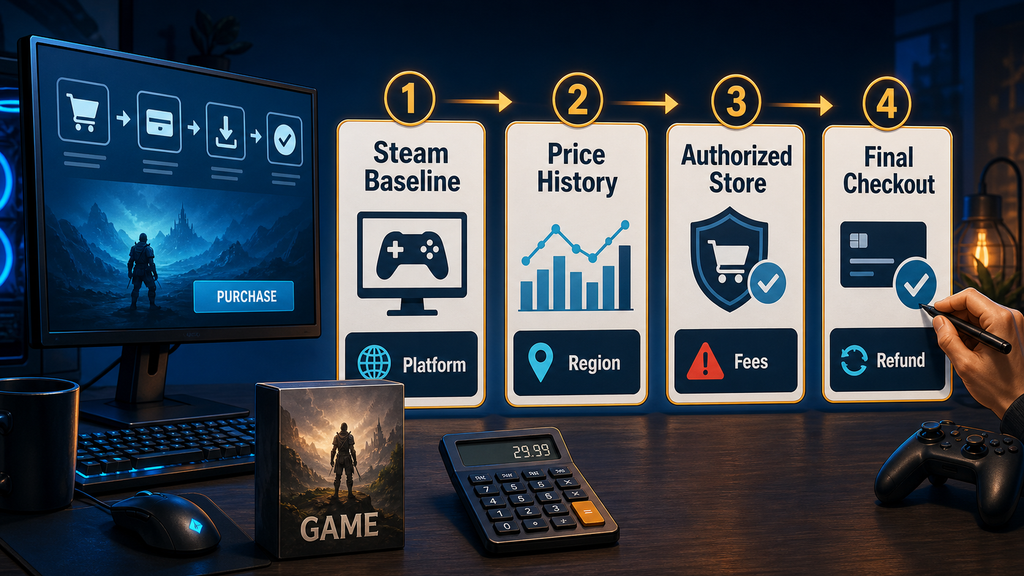
The Four-Check Buying Method
Use this process before buying any discounted PC game.
1. Check the Steam baseline
Search the game on Steam and record the current price. Do not rely only on a crossed-out “regular price” on another site. The official store gives you a useful reference point.
2. Check the historical low
Use a price tracker to see whether the current deal is normal. If the current price is close to the historical low, waiting may not save much. If the price is far above the historical low, add the game to your wishlist and wait.
3. Separate authorized stores from keyshops
Do not compare every listing in one column. Put authorized retailers in one group and marketplaces in another. A $3 difference between those groups is not a fair price-only comparison because the buyer is also comparing supply chain and support risk.
4. Read the final checkout screen
Look for service fees, payment fees, tax, activation platform, region, and refund conditions. The price on the product page is only a starting number. The checkout total is the number that matters.
Which Option Should You Choose?
Choose Steam when the discount is already good, you are unsure whether you will enjoy the game, or you want the clearest refund path. For many buyers, that is the right answer even when another listing is a few dollars cheaper.
Choose an authorized key retailer when the store is verifiable, the key region matches your account, and the final total is meaningfully lower. Use a price tracker to confirm that the deal is real.
Treat a grey-market keyshop as a higher-risk purchase, not a normal discount store. If the saving is only $3 or $4, I would not take the extra uncertainty. I would rather wait for the next Steam sale or buy from an authorized retailer. That is not the most exciting answer, but losing access to a game after a key is revoked is worse than missing a small discount.
It stings to pay more. Still, a cheap key that creates a support problem is not a bargain.
FAQ
Are game keys always cheaper than Steam?
No. Authorized retailers sometimes beat Steam, but Steam sales can be equal or cheaper. Grey-market listings may be lower, but the advertised price may exclude fees and carry more risk.
Is it safe to buy a Steam key from another store?
Safety depends on the seller and the supply chain. Prefer stores verified as authorized resellers, check the region and platform, and use a payment method with buyer protection.
Can Steam refund a key bought somewhere else?
Usually, Steam’s refund system applies to purchases made through Steam. For a key bought from another store, contact that store and check its refund policy before revealing the code.
Should I wait for the next Steam sale?
If the game is not urgent and the current price is far above its historical low, waiting makes sense. The next listed Steam seasonal event is the Autumn Sale, October 1–8, 2026, but individual games can also receive discounts outside seasonal events.
Are grey-market keyshops illegal?
The legal status can vary by country and by how a seller obtained and resold a key. A buyer should not assume that a low price proves a key is legitimate. The practical issue is whether the key is authorized, region-compatible, refundable, and supported.
Final Recommendation
Use Steam as your baseline, IsThereAnyDeal to check authorized alternatives and price history, and the final checkout page to calculate the real cost. Buy from an authorized retailer when the saving is clear. If the difference is only a few dollars, keep the safer refund path and buy through Steam.
For more buying advice, read our Game Key Site Safety: 10 Red Flags Before You Buy, Compare Game Key Prices — Save 50%+ With These Free Tools, and How to Activate Game Keys on Steam, Epic & GOG.
Sources
- Steam Seasonal Sales documentation
- Steam Refunds
- Steam Pricing documentation
- IsThereAnyDeal: authorized store coverage
- FTC: Buying From an Online Marketplace