Disclosure: This post contains affiliate links. If you buy through these links, we may earn a commission at no extra cost to you.
You already know the answer. Nobody types “free VPN vs paid VPN gaming” into Google hoping to hear that free VPNs are great. You type it because you want someone to tell you: can I save $5 a month and still play without lag?
Here is the short answer: no.
Here is the ugly truth: free VPNs do not work for gaming. Not “work okay” in a pinch. Not “work if you pick the right one.” Instead, they spike your ping, sell whatever data they can grab, and get your IP flagged by anti-cheat systems that do not care whether you knew any better. And in the worst cases, they turn your PC into a relay for someone else’s internet traffic — without telling you.
So what do the numbers actually say? Ping, data caps, security, IP reputation — every stat here comes from a published test or documented incident. No filler. No guesswork.
If you are looking for a paid VPN, our best VPN for gaming low ping comparison covers the top picks. If you want to know which games ban VPNs, the game-by-game VPN ban list has the breakdown.
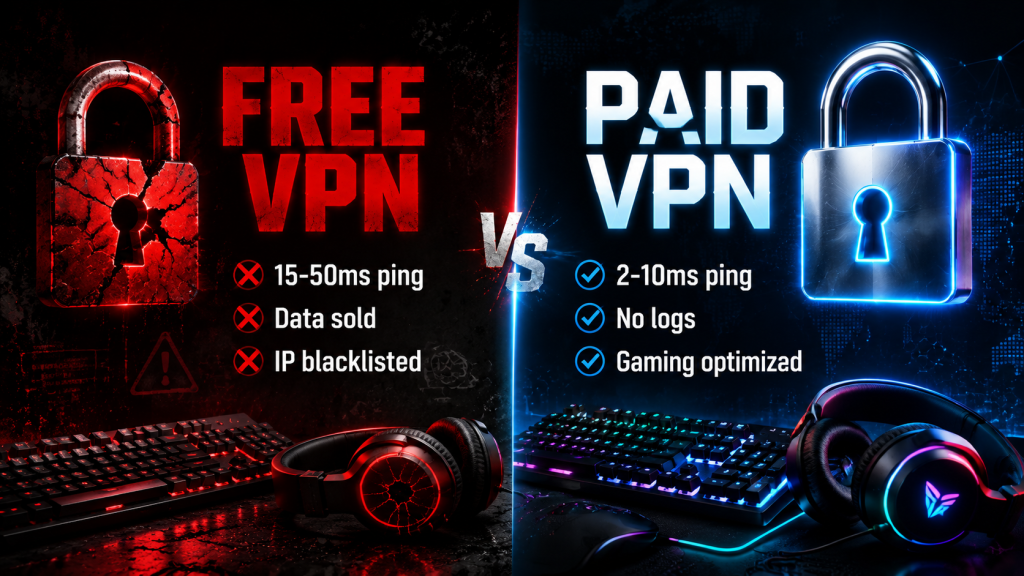
Free vs Paid VPN: The Numbers That Actually Matter for Gaming
| Factor | Free VPN | Paid VPN |
|---|---|---|
| Ping increase | +15 to +50ms | +2 to +10ms |
| Data cap | 2–10 GB/month typical | Unlimited |
| IP blacklisting | IPs broadly flagged | Dedicated IP available |
| Speed retention | 30–70% of baseline | 85–95% of baseline |
| Split tunneling | Rare | Standard |
| Monthly cost | “Free” (hidden costs) | $1.78–$5/mo |
| Gaming verdict | Unplayable | Works |
The AV-TEST 2025 independent benchmark — the most thorough VPN test available — found top paid VPNs added a median of 3–4ms of latency. By contrast, free VPNs typically add 15–50ms because their servers are overloaded and nobody bothered to optimize for gaming traffic.
In a competitive shooter, 15ms is seeing your opponent first or dying before they appear on your screen. Put simply, that 15ms decides who wins. Full stop.
Data caps are the other dealbreaker. A single Call of Duty update runs 50–100 GB — impossible on any capped free plan. Even Proton VPN’s unlimited free tier hits 70%+ server load regularly, forcing mid-match server switches to distant locations. On the Techlore forums, one user put it plainly: “Free servers are speed-capped and a lot slower than premium servers. Latency does increase, so might not be the best idea for gaming.” Windscribe Free is surprisingly fast — 5ms ping on local servers — but caps you at 10 GB per month. That is 60–200 hours of gaming, gone in days if you also browse or stream anything.
What “Free” Actually Costs You
If the product is free, you are the product. Here is how free VPN companies actually make money — and what it costs you.
Your Data, Sold
A 2025 VPN Transparency Report analyzed the top 100 free Android VPNs. The findings: 88% leaked user data, 71% shared data with third parties, and 60% sold data directly to advertisers. Betternet, once one of the most popular free VPNs with 38 million users, was caught running 14 third-party tracking libraries — the most ever found in a VPN. People installed it to escape ISP tracking. Instead, they ended up tracked by dozens of ad networks.
Source: ExtremeTech — Free VPN Data Farming
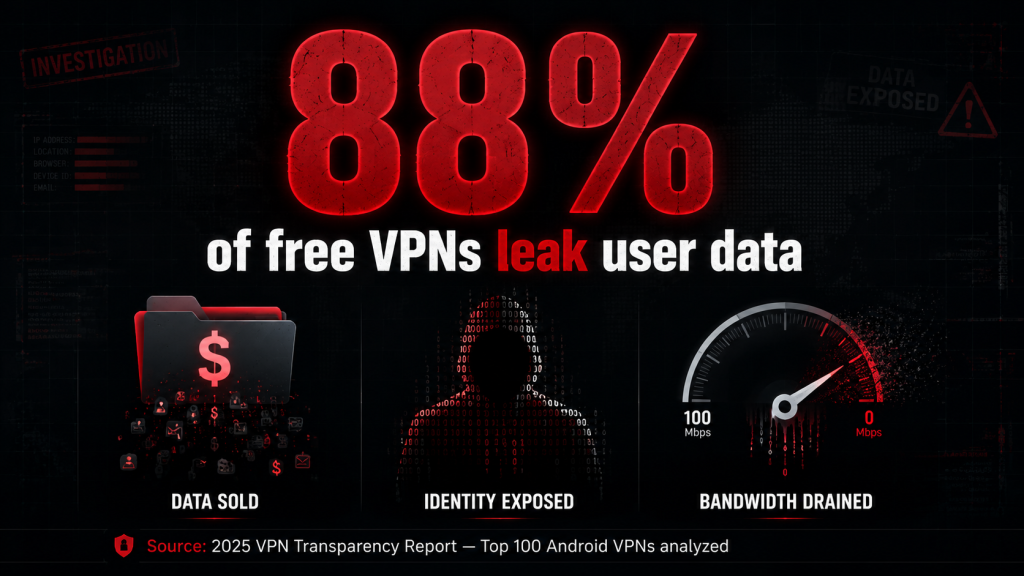
Your Bandwidth, Stolen
Hola VPN has 152 million users. It was caught selling their bandwidth through a subsidiary called Luminati Networks — at $20 per gigabyte. Anyone running Hola became an unwitting exit node for paying customers. Your home IP could be linked to DDoS attacks, fraud, or worse. Security researchers found six zero-day vulnerabilities in Hola’s code, plus five malware samples containing Hola protocol code. Hola is still on app stores.
Sources: PCMag — Hola Sells Bandwidth, ZDNet — Hola Security Flaws
Your Device, Hijacked
In January 2026, Google’s Threat Intelligence Group took down IPIDEA, one of the largest residential proxy networks on earth. Multiple free VPNs — including Galleon VPN, Radish VPN, and DoorVPN — were secretly routing users into this network. The scale: 60 million IP addresses, 550 hacking groups using it in a single week, and 9 million Android devices turned into proxy nodes for criminals. If you gamed through one of these VPNs, your own device was routing traffic for hackers.
Source: PCMag — Free VPNs Used by Criminals
Your Screen, Recorded
In 2025, a Chrome extension VPN called FreeVPN.One — 100,000+ users, Google “Featured” badge and all — started silently capturing full-page screenshots 1.1 seconds after every page loaded. The images were encrypted with AES-256 and sent to a remote server. Then the developer called it “AI Threat Detection” and vanished. Even after that, the extension stayed on the Chrome Web Store for months.
Source: TechSpot — Free VPN Turns Malicious
The One Free VPN That Is Actually Safe
If you cannot pay, Proton VPN’s free tier is the only one worth considering. It gives you unlimited data. Its no-logs policy has been proven in Swiss court. And there have been zero data scandals.
But for gaming, it has serious limits: only 5 countries, auto-assigned servers only, and frequent congestion above 70% capacity. Proton forum users report forced mid-game disconnections when servers auto-switch. Fine for casual play. Not fine for anything competitive.
Source: Wired — Proton VPN Review
How to Spot a Dangerous Free VPN in 30 Seconds
Already have a free VPN installed? Here is the gut check.
First, look up who made it. No company name, no physical address, no privacy policy? Delete it. Second, ask how they make money. If the answer is not obvious — like Proton’s paid-tier-subsidizes-free model — they are selling something. One hard rule: never use a free VPN that is a Chrome extension. A Zimperium zLabs study of 800 free VPNs found 65% had risky security behaviors, and Chrome extension VPNs were the worst by a mile. Last rule: if a free VPN asks for permissions beyond network access — location, camera, contacts — remove it. There is no good reason a VPN needs your camera.
Source: CNET — Free VPN Security Study
I Used to Test Free VPNs. I Stopped.
I have bought and tested VPNs for years. Early on, I tried the free ones because — let’s be honest — who wants to pay for something they can get for free?
The breaking point was not a data leak or a malware scare. In fact, it was simpler than that. I was mid-match in Valorant, round point, and my free VPN server hit capacity and auto-switched. My ping suddenly spiked to 200. Then I rubber-banded into a wall and died. The enemy team walked through the site uncontested. My team lost the round, then the match.
That was the moment I did the math. One lost competitive match because of a VPN glitch, times however many matches I play in a year. Versus $1.78 a month for Surfshark. The math is not close.
I am not saying every free VPN is malware. Proton VPN Free is genuinely safe. But “safe” and “usable for gaming” are two different things. Proton Free works for browsing. For gaming, the server congestion alone kills it.
What a Paid VPN Costs vs What a “Free” One Really Costs
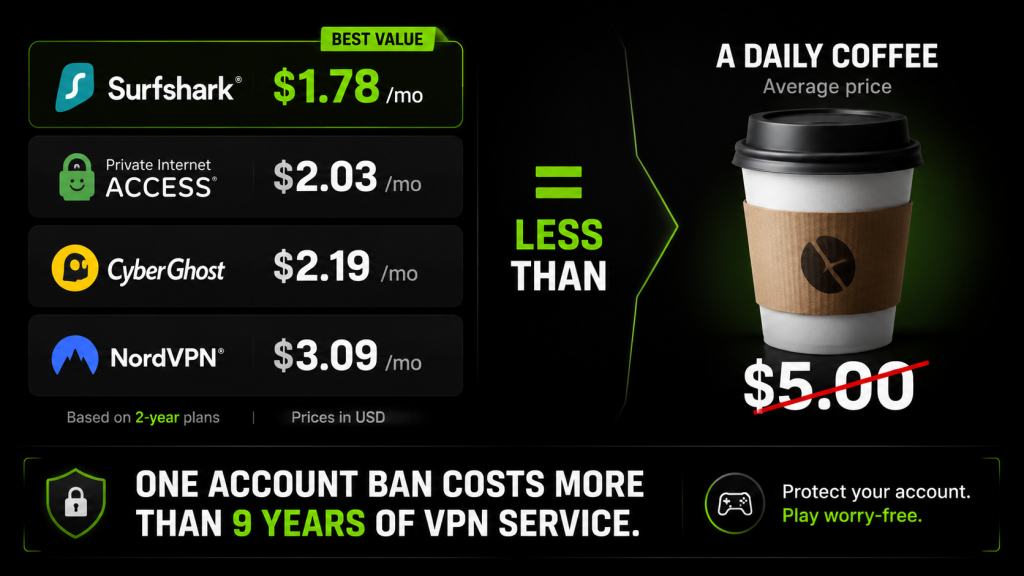
The cheapest paid gaming VPNs in 2026:
| VPN | Monthly (long-term plan) |
|---|---|
| Surfshark | $1.78/mo |
| Private Internet Access | $2.03/mo |
| CyberGhost | $2.19/mo |
| NordVPN | $3.09/mo |
Source: CNET — Surfshark VPN Deal
Still think a free VPN saves you money? Consider this: a Valorant account with $200 in skins, permanently banned because a free VPN IP triggered Vanguard’s anti-cheat — that single incident costs more than 9 years of Surfshark. Or take a device infected by proxy malware from a sketchy VPN, requiring a full Windows reinstall and potential data recovery — also far more than $2 a month.
After that comes the hidden time cost. Losing 30ms of ping to a congested free server, match after match, for months. At competitive ranks, that is not just annoying. In fact, it is exactly why you lose.
Beyond price, the feature gap is just as wide. For starters, split tunneling — routing only your game through the VPN while Discord and Chrome stay on your normal connection — is standard on paid VPNs and nearly nonexistent on free ones. Similarly, kill switches — cutting your internet the moment the VPN drops so your real IP never leaks — are standard on paid and broken or missing on free. Finally, server selection: paid VPNs give you thousands of gaming-optimized nodes, while free VPNs cram everyone onto a handful of overloaded servers in three countries.
The Bottom Line
Free VPNs are not free. You pay with your data, your bandwidth, your ping, or your game accounts. For gaming specifically, the gap is even wider than for browsing: free VPNs lack split tunneling, lack gaming-optimized servers, and their IP ranges are already flagged by every major anti-cheat system. As a result, connecting to Valorant or Warzone through a free VPN is asking Vanguard or RICOCHET to flag your account.
Proton VPN Free is the exception if you play casually and have no other option. For everyone else, however, a paid VPN at $1.78 a month costs less than a single coffee. Do the math: one account ban costs more than a decade of VPN service.
Best gaming VPN head-to-head comparison → | Game-by-game VPN ban risk list → | How to set up VPN split tunneling →
As an Amazon Associate we earn from qualifying purchases. Gaming Routers | Network Switches